
About Me

My photo
I am plain spoken and say what I see, this gets me into a lot of trouble, I am kind and generous beyond normal sometimes and care deeply about my environment and world, my two sons keep me busy and focused most of the time and I have a very busy social network filled with some of the most amazing people possible. I am a student who wishes to teach other adults one day and hope to be successful in transforming individuals one at a time. I am a bahai and a very spiritual being.

Wikipedia

Search results

Tuesday, 4 November 2014

How technology has changed the way we learn

Michael Gove the Education Secretary gave a speech recently about how technology is changing the way we learn, the speech started with a reflection of how technology has changed the world in general and Grove stated "“Most of us carry more advanced technology in the smartphone in our pocket than Neil Armstrong and Buzz Aldrin used to reach the Moon" but he also went on to reflect how much technology has moved the world forward but how the education system has not really changed since the Victorian aged, He even went further to note that a Victorian teacher could probably work just fine in a modern classroom (Gov.uk, 2012).
Now Gove's speech was a few years back but I agree with most of what he said. The technology we use today in all walks of life is so advanced that we do not understand how they work. We have a generation below us who are more likely to learn differently from previous generations and therefore will need teaching in a completely new way. Education has to catch up to society or educators may has well be from the Victorian age for the use they will be to learners.


So what's the answer to the question of how technology has changed the way we learn? Lets go on a journey and find out shall we? I recently gave a lecture on Trans Humanism and how we are through the use of technology able to become more than human. Surely this is already the case for most of the western world and with more and more children being brought up in a technological society it means we must learn fast how to adapt so we don't get left behind. It wasn't so long ago that children learnt through face to face interaction, story books, play, and handwriting exercises. But in 2014 most of those methods are outdated, the use of mobile technology in schools has changed how the lessons are structured, the interactivity of  student and teacher are no longer paramount to learning as the students can be much more self directed with the use of technology.

Prof. Yoram Eshet, (2014) notes that research is currently showing that children already have a high dependence upon technology and computers,  and is currently at the forefront  of many studies on all facets of learning and technologies. One of the most important changes that as evolved from technology is the  shift from passive to active learning or from a teacher-centered to a student-centered approach. This a huge advantage for a student like me who has a learning difficulty, as it puts them in control of their own learning. I came across a great blog,  SHIFT's eLearning Blog written on the topic of technology and learning, the author gutierrez (2014) states "Technology, then, becomes a tool for active learning. Through it, learners are able to research, communicate and solve problems" and I tend to agree, however it must be noted that not everything about  the use of technology  in education is positive. There have been many ways in which we have made changes to the way we has a species learn. Technology can be used as crutch, spelling is no longer something we learn as everything is autocorrected and spell checked.

  Harven (2013) even goes further and states "This may be a larger issue of technology on our memory and brain-strength, but if we are using the Internet in schools, then kids are being taught to use Google to answer all their questions and to essentially, copy and paste their knowledge.  Education needs to figure out how to use technology in a way that does not replace knowledge, but reinforces it." so how do we do this as educators and get a good balance? The way I see it is that education and technology are both tools to improve society and as educators I feel the two should work hand in hand.  In agreement is Gillis (2014) who addresses the fact that technology is a tool and tools work best when used for the purpose they were designed for. Much of technology used in classrooms today is in it's infancy and the efficacy of those tools wont really be known until a generation has passed.

 One thing is for certain that technology has changed the way we learn and the way we teach. Teaching is now an exciting profession to be entering as who knows what the future of learning holds.


References

Gillis, S. (2014). Finding a balance between technology and teaching. Available: http://www.classroomtechnologyhelp.com/finding-a-balance-between-technology-and-teaching-style-in-your-classroom/. Last accessed 13/11/2014


Gove,M . (2013). Michael Gove speech at the BETT Show 2012. Available: Michael Gove speech at the BETT Show 2012. Last accessed 10/11/2014

Gutierrez,M. (2013). How technology has changed us. Available:http://info.shiftelearning.com/blog/author/karla-gutierrez . Last accessed 11/11/2014

Harven, M . (2013 ). Top 5 problems with Technology. Available: http://edtechtimes.com/2013/11/06/top-5-problems-technology-education-today/. Last accessed 09/11/2014.




Review of Learning with E's Blogging!

I spent a good few nights sat at my desk in the dark with just the only light coming from my screen to illuminate my face, looking for a good blog which I felt would be useful to me in my teaching  endeavour. There were so many to plough through (almost like a needle in a haystack), lots of  good pictures, catchy titles and great information but nothing really got me locked in. Until one night just by chance I stumble into this page  I am hooked. He uses all the right buzz words for me and my brain.
Steve Wheeler  states "I'm working through the alphabet of psychologists and theorists, providing a brief overview of each theory, and how it can be applied in education" and this fits perfectly with my outlook on teaching, I love theory and so need to read more on it but just don't have time, now I can read one post a day and all will be revealed.

The blog is set up in such a easy to use way and even has the options to change the design and layout which I think make it so interactive and for my dyslexic issues it makes it easy to read (as I can change the options which suit me best). He looks at how effective are the P L E 's and has posts regarding  the future of technology in education which can be seen here. Every post I come across I find I am super involved and just wish to know more for example what is digital learning.  The blog not only will be useful to enhance and assist my own teaching skills, but I feel the blog has such amazing insights and information it would be useful for almost anyone. I am very excited to have found his blog and that either makes me need to get out more or fully committed to my new role as an educator in the 21st century. Maybe I should let u decide?

Thursday, 9 October 2014

Micro teaching: Change Blindness.


Slideshare is a fantastic application for sharing resources, and gaining information.
First before I could write about my lesson I needed to work out how to get my power point slides upon my blog. I found this website which enables you to upload your power point. It was easy to use and upload but I had an issue trying to work out how to get the power point to show upon my blog rather than just the embedded code. Slide share is a fantastic tool but it does have it's draw backs, once you have uploaded your power point you have let go of your intellectual rights on it. This means anyone can access and use your work in future, now I am not big headed enough to think I am so clever I don't want to share unless for a benefit, but it does mean your work is no longer your own and that I may disagree with.  I  have  posted the webpage I found which taught me how to upload my power point. I think this may be useful to myself and others in teaching.

Now onto my lesson.

I have a passion and love for Psychology. I decided my lesson plan would be based around trying to teach others why psychology is important. The phenomena of change blindness is fascinating and I knew it would engage my class fully. I have posted a quick you tube clip of this below.

I found this website very useful as a starting basis for my research.
 It is important for research to be performed upon such an area so to enhance the understanding of where it may have practical implications.  It would have great importance in the class or lecture room, especially for trainees who are trying to take in a lot of new information at the same time.

My lesson went well, I was nervous and felt I spoke very fast to start with, but I soon fell into a good place when I trusted I knew my subject and that others would enjoy my lesson. I had planned the lesson and had a range activities for everyone to engage with. After an explanation of what psychologists do we did some experiments. I think everyone enjoyed, I know I did.

I feel all grown up!!!

The worry and stress of the last week has been overwhelming. It seems I didn't have a placement for me to teach on and observation week was to commence. I was left feeling lost and confused about what to do next. The response of my classmates was one thing I didn't bargain for, I was overwhelmed at their kind words for me and their support. After a weekend of worry a place was found for me within the university upon the degree which I have just graduated from. It is like a dream come true. I was able to meet with my mentor who was my favourite tutor in the degree and I being given the opportunity to have a huge input in to the course content. I have been out this week having an observation week and it has been breath taking. Walking into a lecture hall as a student was exciting but walking into the same hall as a trainee lecturer took my breath away. The room looks so much smaller now than it did before but I think that may just be my perception.
 

I will be doing blended learning course which is so exciting. I shall be given an opportunity to learn many different types of teaching techniques all of which will require the use of technology. I really feel so lucky and blessed to have been given such a unique opportunity that just a few weeks ago would have been unobtainable for me. Blended learning Is the Future.

I have found some interesting websites regarding blended learning and distance learning and will add anything I find in the future. So my blended learning journey starts here.

Wednesday, 8 October 2014

The value of mobile technology in teaching and learning


It is difficult to find a corner of the western world which hasn't gone mobile in terms of technology. We have a generation which carries around their computer, access to the web, cameras and means of communication all in one device in their pockets.  So it can been seen why it would be of special interest to educators to find a means of  exploiting this mobile technology for use in learning.
Going back a few years to when I was in education the thought of mobile technology was so foreign. The personal computers (pc) we had just back in the last decade were desk tops and had black and green screens.


Jump forward to the modern day and well it is a stark contrast.


If it is easy to see the impact of mobile technology on the way we live as a species then it seems obvious to see the value of mobile technology in the way we teach and thus learn.
Bright (2014) suggests that a more blended approach to the way we teach is more likely to cater to everyone. Now I am in agreement with Bright due to the fact I myself am teaching upon a blended learning program which involves some face to face teaching but mainly the use of technology for teaching where ever the students wishes to learn. One of the benefits of using mobile technology to teach is that of ease of access, mostly everyone now has access to 24/7 up to date knowledge at the touch of a button. So everyone is constantly tapped into some form of information base most of the time. This can be utilised and as Nasmith (2014) suggests whether they are welcome in the classroom right now or not, mobile devices are finding their way into classrooms in children’s pockets, thus it wold be good educational practise to find a way to incorporate these technologies. The infrastructure of education needs to change to adapt to the demands of the learners.

It is clear to see one of the main values of mobile technology for learners is the "anytime, anywhere" capability that mobile devices encourage. The learning gets taken out of the teacher led classroom environment and thus becomes student lead. This may however present a significant challenge to conventional teaching practises.
Weldon (2013) looked at two distinct studies which found that mobile technology did indeed make a difference in learning and teaching. Some of the findings of the study suggested that students had greater access to learning resources and their use of the devices for education purposes exceeded the researcher's expectations. Teachers increased their communication with students and
 Students changed their learning behaviour. It is clear to see with these results that there is great value to mobile technology and learning, but me being the critical thinker I am I looked further, this study was funded by sponsored by Kajeet, a wireless service provider that focuses on educational technology, so what did they expect for their money? We have to be careful when we are putting education behind money and not the other way around.

One way to make certain of the value of technology in teaching and learning will be to work in collaboration with learners, educators and content creators to ensure all technology is accessible and relevant to users. Usability should account for those who will be using the mobile devices for teaching in relation to those who will be using it for learning. If all bases are covered then the value will doubled for all users.

We all know the key to transforming societies is in education but is the way to change education now through mobile technology?  Each new generation changes the direction in which society develops and it should be of no surprise that young people want to employ mobile devices to make education more engaging and personalize it for their particular needs (West ,2013). It can be said that Technology-rich activities can sustain high levels of student engagement and peer collaboration compared to less technology focused activities. I can even see this at play in my own home with my own children, they grunt at each other most of the time but use applications to chat and collaborate ways to get money out me constantly. I think the key now is educating the educators to be open and accepting of the vast value mobile technology now has in the realm of teaching and learning so the new generation have a opportunity to change the direction of western society for the better. 


References


Bright,S. (2014). Pros and Cons of Blended Learning. Available: http://www.digitalchalk.com/blog/pros-and-cons-of-blended-learning. Last accessed 15/11/2014


Nasmith, L . (2004). Mobile Technologies and Learning. Available: http://www2.futurelab.org.uk/resources/documents/lit_reviews/Mobile_Review.pdf. Last accessed 15/11/2014.

Weldon, D. (2013). Recent studies confirm value of mobile technology, tablets in classroom. Available: http://www.fiercemobileit.com/story/recent-studies-confirm-value-mobile-technology-tablets-classroom/2013-12-05. Last accessed 15/11/2014

 West, D . (2013). Mobile Learning: Transforming Education, Engaging Students, and Improving Outcomes. Available: http://www.brookings.edu/research/papers/2013/09/17-mobile-learning-education-engaging-students-west. Last accessed 15/11/2014.

Wednesday, 1 October 2014

bubble.us


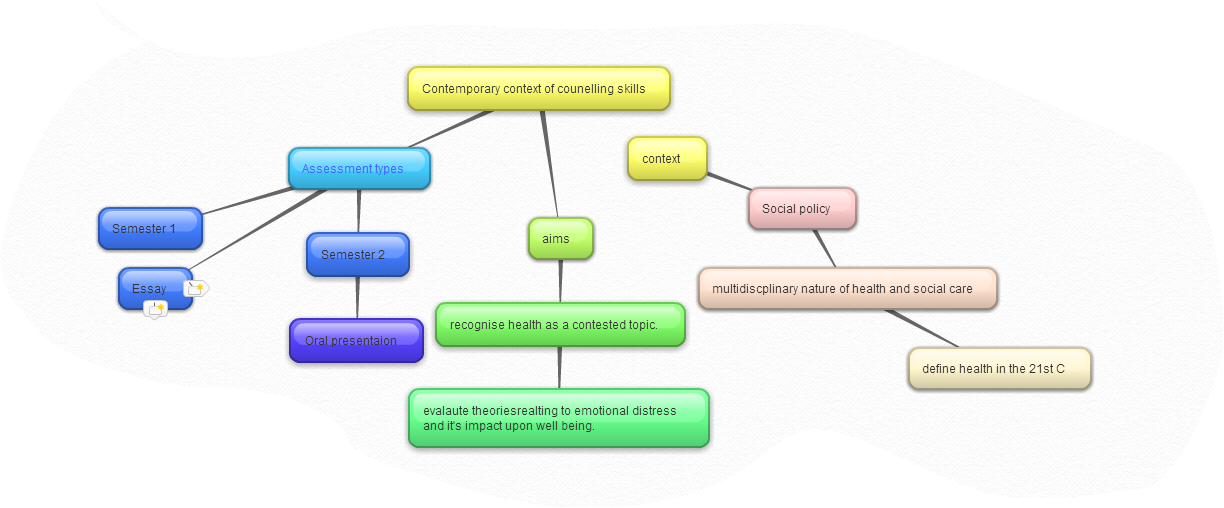
Today we worked with an application known as Bubbl.us. I must be honest I couldn't see it being used much within the area I am teaching within apart from my own personal use. It would be useful as a tool to plan a series of lessons with the overall objectives clear to see.  I have also looked into why others would use brainstorming.

  I also have a program upon my laptop mind maps which is a tool directly linked to my dyslexia. I have not used this program but will be trying to work my way around it in future.
This application can be used for reflective practise within the field of teaching. An idea can be developed from one single word or theme.

I think this application would be an effective tool to use in lesson or scheme of work planning and I am going to develop one upon a  10 week scheme of work I am currently working on.

Once I started playing around with the application though I started to see uses for it within my subject field. In counselling theory classes it can be used to develop a students understanding regarding a subject or concept which has been taught. I did this as an example and used the Snippet Tool to place into my Blog
  This is a useful source for anyone who is a visual and kinaesthetic  learner.  I myself find I prefer to do rather than read, using colour also engages part of my brain which reinforces the learning.
I also found that when I tried to use Bubble.us again I had forgotten a little so found this little tutorial on YouTube which helped.

Q R

This was a lesson on Q R Codes, I found them very easy to create but a little more difficult to embed into a blog and poster. I was interested that the fact that they are quick response codes as they are very quick to scan and create a link to a wealth of information at the touch of a button. In regards to using this tool in teaching I found a good few links